
Industry needs technical reality, not just AI
Industrial companies are investing in digitalization, data platforms, digital twins, and artificial intelligence. However, many projects run into a fundamental limitation: Machines provide data, but their behavior is rarely described in a formal and traceable way.
This gap is becoming a central issue in modern automation. A system can function reliably even if its states, transitions, reactions, and deviations are not clearly mapped. Knowledge is scattered across specifications, PLC code, HMIs, documentation, and individual experts. As a result, there is no common technical frame of reference for engineering, operations, diagnostics, and AI.
With increasing complexity, a shortage of skilled workers, shorter product cycles, and new requirements for transparency, traditional automation is no longer sufficient. PLC code describes the implementation, but not necessarily the technical reality of a machine. Data only becomes valuable when it is linked to a system’s expected behavior.
Selmo Technology sees this as a crucial next step for the industry. “The question is not just whether machines are becoming smarter. What matters is whether their behavior remains explainable, controllable, and traceable throughout their lifecycle,” the company explains.
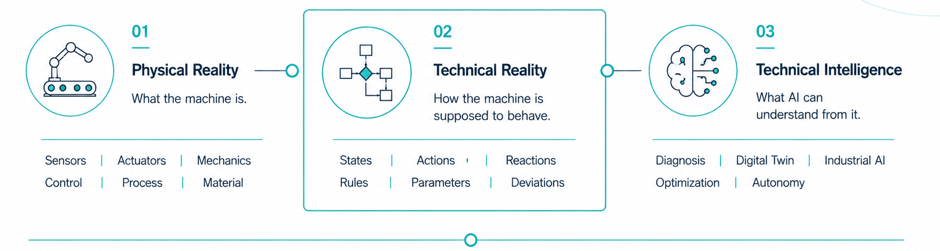
The approach: Machine behavior is formally described and made usable as a technical reality bridging the physical system and digital intelligence. This enables control logic, user interfaces, diagnostics, data structures, digital twins, and AI applications to be developed on a common foundation.
This shifts the focus of industrial digitalization: The emphasis is no longer on data alone, but on understanding what a machine is supposed to do, is allowed to do, and actually does. For machine builders, operators, and industry decision-makers, technical reality becomes a prerequisite for industrial AI.
Sie wollen mehr darüber erfahren?
