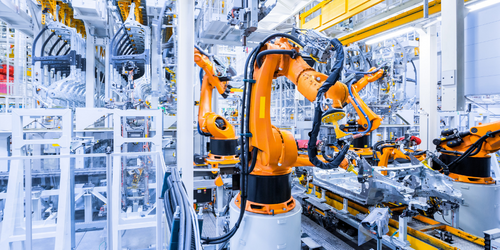
Why Transparent Machine Logic Is Becoming a Prerequisite for Scalable Automation and Industrial AI.
The manufacturing industry is investing globally in automation, industrial AI, and digital production systems. Nevertheless, many smart manufacturing initiatives fall short of expectations. The reason often lies not in a lack of technology, but in a structural gap at the machine level that persists in many production systems to this day.
Companies are increasingly investing in automation, artificial intelligence, analytics, connectivity, and cloud technologies. The goal is to boost productivity, optimize processes, and ensure long-term competitiveness. According to Deloitte’s “2025 Smart Manufacturing and Operations Survey,” 92% of executives surveyed at large manufacturing companies headquartered in or operating in the U.S. view smart manufacturing as a key driver of their competitiveness over the next three years. Expectations for smart manufacturing are correspondingly high—and they are justified. Yet while data, systems, and production processes are becoming increasingly digitized, one key aspect often remains largely unchanged: the logic of the machines themselves.
The reason for this often lies not at the level of dashboards, data platforms, or AI applications. Rather, in many factories, the core of the production system remains difficult to access: the behavior of the machines. Although systems today are networked, visualized, and continuously monitored, their underlying logic is often difficult to understand. Knowledge is not fully documented, is concentrated among a few specialists, and remains largely invisible to other systems, which hinders knowledge transfer and limits scalability.
The Structural Gap in Modern Factories
Many transformation programs focus on the visible aspects of digitalization. Dashboards, MES systems, reporting solutions, and industrial AI create transparency and provide valuable insights. However, if the underlying machine behavior remains difficult to understand or control, these technologies reach their limits. As a result, companies are increasingly optimizing the systems surrounding the machine without making its underlying logic equally accessible.
The consequences are evident throughout the entire lifecycle of a system. Repeated programming, delayed commissioning, prolonged fault diagnostics, and a high dependence on experienced specialists incur costs that are often not immediately visible but have a lasting impact on competitiveness. At the same time, these factors make it difficult to reuse standards and transfer improvements to other systems or locations. The increasing connectivity of production does not automatically solve this problem: A connected machine is not necessarily a machine that can be understood.
Industrial AI Places Greater Demands on Machines
With the increasing use of industrial AI, the traceability of machine behavior is becoming even more important. Artificial intelligence requires unambiguous machine states, consistent events, and traceable processes. Without these fundamentals, it must deduce relationships from ambiguous signals. As a result, many applications remain limited to pilot projects and are difficult to scale. Thus, transparent machine behavior is increasingly becoming a prerequisite for smart manufacturing and industrial AI to truly realize their potential in practice.
„Smart manufacturing does not succeed simply by introducing more and more technology into production. What matters most is that machine behavior becomes transparent, traceable, and controllable. Only then can production systems be efficiently commissioned, standardized, and scaled sustainably." — DI DI(FH) Markus Gruber, Gründer und CEO, Selmo Technology GmbH
Investment in smart manufacturing will continue to rise. In the future, however, the key will be whether we succeed not only in digitizing data, but also in making machine behavior explicit, understandable, and controllable. Only when this operational foundation is in place can digital technologies, standards, and AI applications reliably build upon it.
This is precisely where Selmo comes in with its behavior-centric approach. The approach aims to transform the logic at the machine level from a hard-to-access “black box” into a structured and controllable foundation for commissioning, operation, and scaling.
Click here for the press release

 DI Markus Gruber
 DI Markus Gruber : Mar 3, 2026, 9:46:16 AM