
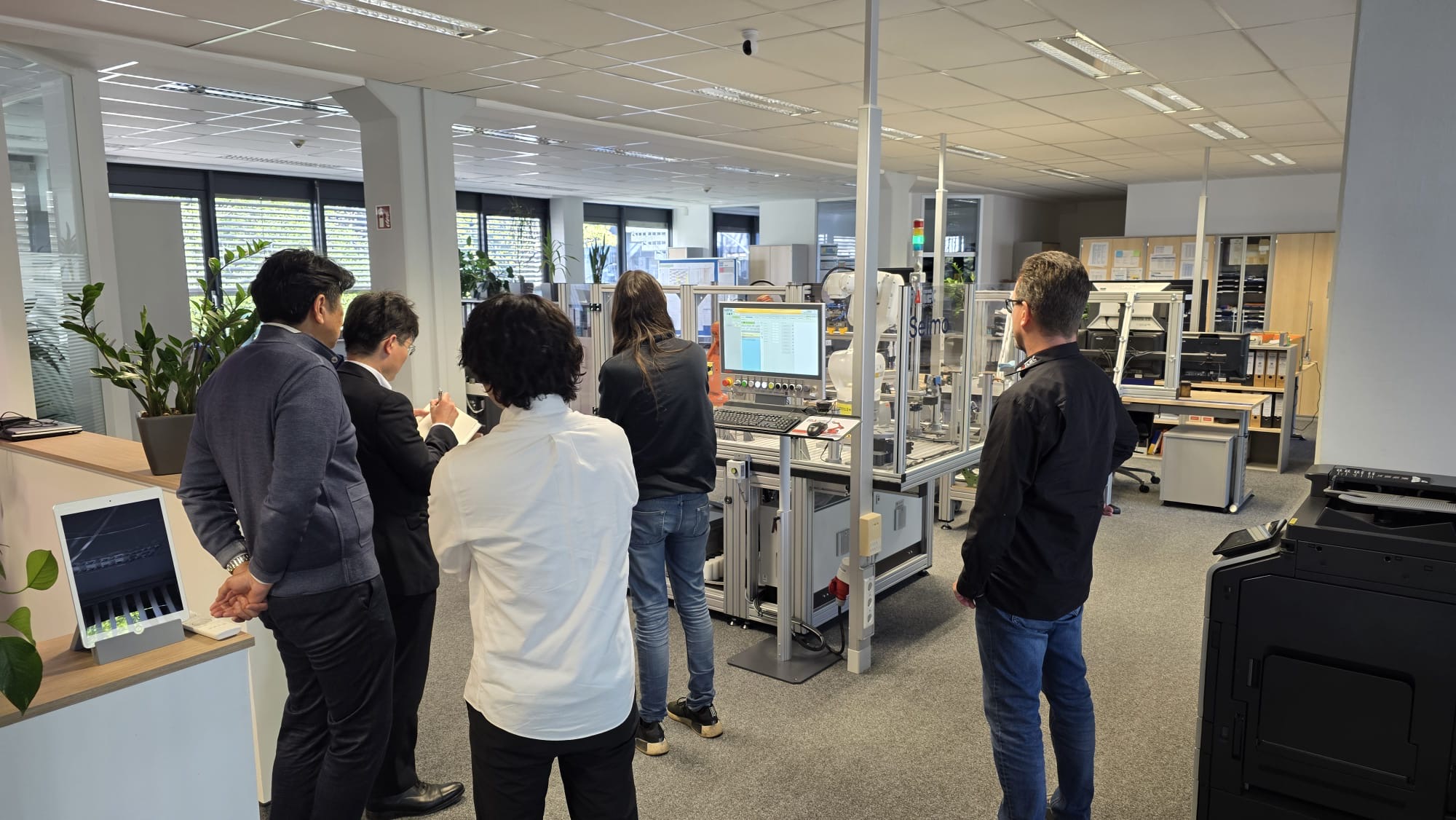
Selmo and Raitec Automation recently welcomed a Japanese delegation to the Raitec office in Munich. The visit focused on gaining practical insights into current approaches in industrial automation and exchanging perspectives on how complex systems can be better understood and managed.
At the center of the discussions was a question that is becoming increasingly relevant across the industry: how can machine behavior be defined in a way that makes systems not only functional, but also transparent and scalable?
The visit began with a brief introduction round at the Raitec office. It was followed by a live demonstration of a test cell, where participants could observe how structured machine behavior is applied in a real industrial environment. Even in more complex scenarios, the system remained understandable, illustrating how clarity and flexibility can be combined in practice.
A central highlight of the visit was the live demonstration of our test cell directly on site. The guests were able to experience the performance and flexibility of our solutions in a practical setting. — Philipp Lorenz, Roboterprogrammierung at Raitec Automation
In addition, the digital twin of the test cell was presented. By simulating processes and system behavior before implementation, the digital twin enables early validation and supports data-driven decision-making. In combination with structured automation, this creates a more predictable and controllable foundation for industrial systems.

During the visit, the delegation was also introduced to Selmo’s approach to structured automation. Instead of relying on logic that is hidden in code or tied to individual expertise, the focus is placed on clearly defining machine behavior before implementation. This principle is closely related to WhiteBox Engineering, where system behavior is formally described and becomes understandable, testable, and reproducible.
Throughout the exchange, the transition from traditional BlackBox systems to more transparent WhiteBox architectures was a recurring theme. In many industrial environments, system logic is still difficult to trace and often only becomes visible during operation. Defining behavior upfront creates a shared understanding and reduces uncertainty when systems are modified or scaled.
The goal is not to make machines work. The goal is to define their behavior before they are implemented. Only then does automation become understandable, testable, and scalable.— Markus Gruber, CEO Selmo
The visit also included time for in-depth technical discussions, allowing specific topics to be explored in more detail. Overall, the visit reflects a broader development in industrial automation. The focus is shifting from systems that simply work to systems whose behavior is clearly defined and understood. Structured machine behavior is becoming a key element in this transition, particularly in the context of Industry 4.0.